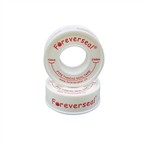
While recognizing the importance of search engines, it needs to be noted there are various other types of performance PTFE tapes that can be used in industries like packaging, electronics, manufacturing, and aerospace. The most common types of PTFE tape include skived, calendared, extruded, coated, and laminated. What characterizes the different types of PTFE tape is the manufacturing process utilized to produce them. These processes are what give PTFE tape superior performance characteristics like high density, elongation, and tensile strength. The adhesive backing is composed of either silicone or acrylic adhesive.
PTFE Tape– consists of PTFE billets or blocks shaved or “skived” to achieve the nominal film thickness. In example, think of an old-style spindle potato peeler, the potato is placed on a hand cranked spindle while a spinning knife is held against the potato to peel its outer layer. Skived PTFE shares a similar process but incorporates a high torque motorized shaft that is spun against a fixed blade across the full width of the PTFE billet to achieve a desired film thickness. After skiving is complete PTFE film then goes through a treating process to enable an adhesive coating to be placed on the film, creating PTFE tape.
Benefits of skived PTFE:
Made from Natural Skived PTFE Film
Available as thin as .0005″, and in thicker gauges up to .125”
Calendared PTFE Tape– This refers a process that melts PTFE polymers into a sheet or film. This done by a machine utilizing high heat and hard pressure rollers to compress and mold the PTFE into the desired film thickness.
Benefits of calendared PTFE:
Smooth surface quality
Reduced Skive Lines
Great thickness accuracy
PTFE Coated Tape– These types of PTFE tapes are commonly made up of fiberglass fabric substrates that are dispersion coated with Teflon™ PTFE. These are made from tightly woven fiberglass fibers that provide dimensional stability while the PTFE coating provides a slippery, anti-friction release surface. There are two universal grades of PTFE coated fiberglass tapes, standard or ultra-premium grade. These types are individualized by the grade of woven fiberglass fibers and the amount of PTFE coating. These tapes utilize two adhesive backing systems in either silicone or acrylic adhesive. Silicone is frequently used for high temperature applications or applications that require easy removability and clean release. Acrylic is used for applications that require stronger bonding adhesion or a higher initial tack adhesion. A specialty tape known as “Zone Tape” is a PTFE coated fiberglass tape that is used for applications that require adhesive on only certain parts of the tape leaving the center of the tape as the non-adhesive “free zone”.
Laminated PTFE Tape– These types of PTFE tapes utilize the same fiberglass fibers as PTFE coated fiberglass tapes; however PTFE is laminated on to the fiberglass creating a more durable and longer lasting surface. Laminated PTFE tapes are more flexible and have an extended application life compared to traditionally coated PTFE tapes.
How PTFE tapes can be used in applications
PTFE’s versatile performance properties including non-stick release, high temperature, water and chemical resistance, and dielectric strength enable PTFE tapes to be used in a variety of applications. These properties help to improve performance where physical characteristics are important. Common PTFE Tape applications include wrapping, insulating, separating or gap filling.
For conformable applications, high-density PTFE, R-Series, or FST Tape are ideal choice for these types of applications. Their low elongation properties and special manufacturing processes make them ideal for wrapping applications. For example, high-density PTFE can be used for high temperature insulation applications. Skived HD PTFE Tape meets MIL-I-23594C U.S. Government specifications and is commonly used in aerospace applications to wrap airframe wire harnesses. R-Series PTFE tape can be used to wrap neoprene drive rollers on conveyor systems as it does not curl or wrinkle. Due to it high tensile strength and toughness, FST tape can also be used as roller protection wrapping. This tape is commonly used in flat die extrusion of polyethylene coatings and other lamination applications.
For insulating or masking applications, skived PTFE is recommended for its superior insulating strength, release properties as well as chemical and temperature resistance. Standard skived tapes are highly conformable with 300% elongation, perfect for masking applications to conform around corners and edges. For gap filling, separating, or insulating materials thick gauge “FAT” PTFE tape (.020”-.125”) can be used to create dielectric insulation, a high temperature barrier, or a non-stick separator. Skived PTFE tape has high dielectric strength which makes it ideal as an insulator in electronic applications.
For applications requiring durability coupled with non-stick properties, PTFE coated fiberglass tape or PTFE laminate tape are recommended. PTFE Fiberglass tapes are commonly used in packaging applications on form/fill/seal machines to cover hot wires or heat-sealing jaws. They are also used on conveyor systems as release liners to eliminate friction on high traffic areas.