Latest Products


Contact Us
- No.278, Qingxian Road, Linglong Street, Linan, Hangzhou, Zhejiang, China.
- fiona@foreverseal.com
- +8613396551886


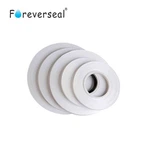
PTFE Cabling Tape
PTFE(Polytetrafluorethylene)
Expanded, natural or colors
Thickness: 0.076mm
Width: 4mm -200mm
Standard density: 1.60g/cm3
Description
Design engineers most commonly use PTFE cabling tape for insulation of aircraft electronic equipment hookup wire for military and commercial uses. Engineers wrap PTFE cabling tape around a conductor and then heat sinter it to produce potent electric wires with integrity, rigidity and uniform insulation. Engineers use PTFE cabling tape to create high-speed data cables of superlative quality and with minimal signal loss.
PTFE is one of the most popular materials due to its many properties, electrical resistance being one of the most popular. Due to its extraordinary dielectric strength and high breakdown voltage, PTFE is an indispensable material in heavy-duty electrical applications.
- Material
● PTFE(Polytetrafluorethylene)
● Expanded, natural or colors
● Thickness: 0.076mm
● Width: 4mm -200mm
● Standard density: 1.60g/cm3
- Technical Data
|
Thickness |
0.0030" |
|
(0.076mm) |
|
|
Tolerance |
±0.00020" |
|
±0.005mm |
|
|
Width |
4 - 200mm |
|
Density |
1.6g/cm3 |
|
Tensile Strength(minimum) |
10 MPa |
| Elongation (minimum) |
50% |
|
Joint Free Lengths |
> 200m |


- Our certificate


- Product Application

ETFE vs. XL-ETFE vs. PTFE: Which is best for wire circuit protection?
Considering the physical properties of these two polymers, there are some differences between the two. ETFE's tensile strength can be 34% higher than PTFE. PTFE is more flexible and has a higher elongation at break (66%). Additionally, PTFE does have one significant advantage, and that's the coefficient of friction. PTFE has one-third the coefficient of friction of ETFE, making it a more ideal wire insulator in areas where wire bundles may rub against each other.
There are also significant differences in the thermal properties of each material. The melting temperature of PTFE is 327 o C and that of ETFE is 267 o C, but both materials begin to soften at lower temperatures. Therefore, the material operates at a lower temperature. Additionally, PTFE has a limiting oxygen index (minimum oxygen percentage concentration for polymer combustion) greater than 95%, while ETFE has a limiting oxygen index between 30-36%, meaning PTFE should be considered for use in environments with higher oxygen content .
A concern with both materials is the prolonged outgassing of fluorine (outgassing is the escape of a component of the insulation material (in the case of PTFE and ETFE, fluorine) from the insulation material) . Free fluorine atoms in these materials can produce corrosive hydrofluoric acid, which is of greatest concern in enclosed areas.
Finally, it's worth noting that there are also cross-linked ETFE lines on the market. The cross-linked ETFE (XL-ETFE) process forms bonds between ETFE polymers, making the material stronger and capable of higher temperature ratings. There are other differences in performance, but overall, XL-ETFE can be considered a harder material.
FAQ:
Customer: What is the ptfe film popular thickness?
Foreverseal: 0.051mm, 0.127mm, 0.153mm are more popular.
Customer: What's your main product?
Foreverseal: We produce ptfe tape for pipe sealing, and ptfe film for cable insulation
Customer: What certificate do you have?
Foreverseal: ISO9001, UL, WRAS, CE, ROHS, ACS
You Might Also Like