


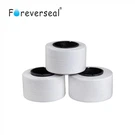


Hey there! I'm a supplier of Porous PTFE Film, and today I'm gonna take you through the process of how this amazing material is made.


Understanding PTFE
First off, let's talk a bit about PTFE. PTFE, or Polytetrafluoroethylene, is a synthetic fluoropolymer. It's well - known for its non - stick properties, high chemical resistance, and low friction coefficient. These features make it a popular choice in a wide range of industries, from aerospace to medical.
Starting with the Raw Material
The process of making Porous PTFE Film begins with the raw PTFE resin. This resin is in a fine powder form. We start by mixing it with a lubricant. This lubricant is important as it helps in the extrusion process. The mixture needs to be homogeneous, so we use special mixing equipment to ensure that the lubricant is evenly distributed throughout the PTFE powder.
Extrusion
Once the mixture is ready, it's time for extrusion. We feed the mixture into an extruder. The extruder is a machine that applies pressure to force the mixture through a die. The die determines the shape and size of the initial PTFE product. In our case, we're aiming for a thin film - like shape. During extrusion, the temperature and pressure need to be carefully controlled. If the temperature is too high, the PTFE can start to break down. If the pressure is too low, the extrusion process won't work properly.
Calendering
After extrusion, the PTFE material goes through a calendering process. Calendering involves passing the extruded PTFE between a series of rollers. These rollers compress and stretch the material, making it thinner and more uniform. The calendering process also helps to align the PTFE molecules in a more organized way. This alignment is important for the mechanical properties of the final porous film.
Removing the Lubricant
The lubricant that we added at the beginning needs to be removed. We do this by heating the calendered PTFE material. The heat causes the lubricant to evaporate. This step is crucial because the presence of lubricant can affect the porosity and other properties of the final film.
Stretching
Now comes the key step in creating the porous structure - stretching. We stretch the PTFE film in one or more directions. This stretching process creates small pores in the film. The degree of stretching determines the size and density of the pores. By controlling the stretching parameters, such as the stretching ratio and the speed, we can customize the porosity of the film to meet different application requirements.
Sintering
After stretching, the film goes through a sintering process. Sintering involves heating the film to a high temperature, close to the melting point of PTFE. This causes the PTFE molecules to fuse together, strengthening the film and making it more stable. The sintering process also helps to set the porous structure that was created during stretching.
Quality Control
Throughout the entire manufacturing process, we conduct strict quality control. We check the thickness, porosity, and other properties of the film at various stages. We use advanced testing equipment, such as electron microscopes to examine the pore structure, and mechanical testing machines to measure the strength and flexibility of the film. Only after passing all the quality tests can the Porous PTFE Film be considered ready for the market.
Applications of Porous PTFE Film
Porous PTFE Film has a wide range of applications. In the medical field, it can be used for wound dressings because of its breathable and non - stick properties. In the electronics industry, it's used for cable insulation. Check out PTFE Cable Insulation Film for more details on its use in cables. It's also used in filtration applications, where its porous structure allows for the separation of different substances.
Our Product Range
We offer different types of PTFE products related to porous films. For example, Unsintered Ptfe is a product that can be used in certain applications where a less - processed PTFE material is required. And Low Density PTFE Cable Tape is great for cable insulation, providing good electrical performance and flexibility.
Why Choose Our Porous PTFE Film
We take pride in our manufacturing process. We use high - quality raw materials and state - of - the - art equipment to ensure the best quality of our Porous PTFE Film. Our products are reliable, and we can customize them according to your specific needs. Whether you need a film with a specific pore size, thickness, or other properties, we can work with you to create the perfect solution.
Let's Talk Business
If you're interested in our Porous PTFE Film or any of our other PTFE products, we'd love to hear from you. Whether you're in the medical, electronics, or any other industry, we can provide the right PTFE solution for your needs. Contact us to start a discussion about your requirements and how we can help you.
References
- Smith, J. (2020). PTFE Manufacturing Processes. Journal of Polymer Science.
- Brown, A. (2019). Applications of Porous PTFE in Various Industries. Industrial Materials Review.