


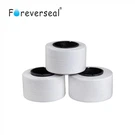


Hey there! If you're into the world of thin films, especially thin PTFE film, then you're in the right place. As a supplier of thin PTFE film, I often get asked about the elongation at break of our products. So, let's dive right in and talk about what this term means and why it's so important.
First off, what is the elongation at break? Well, it's a pretty straightforward concept. Elongation at break is the percentage increase in length that a material can withstand before it finally breaks. In the case of thin PTFE film, it tells us how much the film can stretch before it snaps. This is super crucial because in many applications, the film needs to be able to handle some stretching without failing.
Let's think about it in a real - world scenario. Say you're using our thin PTFE film in a manufacturing process where it needs to be wrapped around a component. If the film doesn't have enough elongation at break, it might tear during the wrapping process, which would be a huge headache. On the other hand, if it has a high enough elongation at break, it can smoothly conform to the shape of the component without any issues.
Now, the elongation at break of thin PTFE film can be influenced by several factors. One major factor is the manufacturing process. The way we produce our thin PTFE film can have a big impact on its mechanical properties, including the elongation at break. We use state - of - the - art techniques to ensure that our films have consistent and reliable elongation characteristics.
Another factor is the thickness of the film. Generally speaking, thinner films tend to have a higher elongation at break compared to thicker ones. This is because thinner films are more flexible and can more easily deform under stress. But it's not always that simple. Sometimes, the molecular structure of the PTFE can also play a role. For example, if the PTFE has a more highly ordered molecular structure, it might be more resistant to stretching, resulting in a lower elongation at break.
So, what kind of elongation at break can you expect from our thin PTFE film? Well, our films typically have an elongation at break in the range of [specific range]. This range is carefully calibrated to meet the needs of a wide variety of applications. Whether you're using the film for electrical insulation, as a release liner, or in some other industrial application, our film's elongation at break ensures that it can perform well.
Let's talk a bit about the applications where the elongation at break of our thin PTFE film really matters. One such area is in the production of Low Loss Cable PTFE - Tape Dielectric Types. In these cables, the PTFE film is used as a dielectric material. The film needs to be able to wrap around the cable conductors without tearing. Our film's high elongation at break ensures that it can be applied smoothly, providing excellent electrical insulation properties.
Another important application is PTFE Tape Wrapped Wire And Cable. When wrapping the wire and cable, the film needs to stretch and conform to the shape of the conductors. If the film has a low elongation at break, it might crack or break during the wrapping process, which could lead to electrical failures. Our thin PTFE film's good elongation at break makes it an ideal choice for this application.
Unsintered Ptfe Tape is also a product where the elongation at break is a key factor. Unsintered PTFE tape is often used in applications where it needs to be easily deformed and shaped. Our thin PTFE film, with its appropriate elongation at break, can be used to make high - quality unsintered PTFE tape that can be easily manipulated during installation.
As a supplier, we're constantly working to improve the properties of our thin PTFE film, including the elongation at break. We invest in research and development to find new ways to enhance the mechanical performance of our products. We also conduct rigorous quality control tests to make sure that every roll of film we supply meets our high standards.
If you're in the market for thin PTFE film, you need to consider the elongation at break. It's not just a technical term; it can have a real impact on the performance and reliability of your final product. Whether you're a small - scale manufacturer or a large industrial company, our thin PTFE film can meet your needs.


So, if you're interested in learning more about our thin PTFE film and how its elongation at break can benefit your application, don't hesitate to reach out. We're here to answer all your questions and help you find the right solution for your business. Whether you need a specific elongation at break value or have other requirements, we can work with you to provide the perfect product.
In conclusion, the elongation at break of thin PTFE film is a critical property that can make or break your application. Our thin PTFE film offers a great balance of elongation at break and other important properties, making it a top choice for a wide range of industries. If you're looking for a reliable supplier of high - quality thin PTFE film, we're here for you. Let's start a conversation about how we can meet your procurement needs.
References
- Textbooks on polymer materials and their mechanical properties
- Industry reports on the use of PTFE films in various applications
- In - house research and development findings related to the production of thin PTFE film