


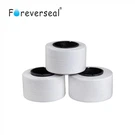
Hey there! As a supplier of Porous PTFE Film, I've been getting a lot of questions lately about how gas separation performance depends on porosity. So, I thought I'd take a deep dive into this topic and break it down for you.
First off, let's talk about what porosity actually means. In simple terms, porosity refers to the ratio of the volume of pores in a material to the total volume of the material. For porous PTFE films, these pores play a crucial role in determining how well the film can separate different gases.
When it comes to gas separation, the key is to have a material that allows certain gases to pass through while blocking others. This is where porosity comes in. The size, shape, and distribution of the pores in a porous PTFE film can greatly affect its gas separation performance.
Pore Size and Gas Separation
One of the most important factors is the pore size. Different gases have different molecular sizes. For example, hydrogen molecules are much smaller than carbon dioxide molecules. If the pores in the PTFE film are too large, all gases will be able to pass through easily, and there won't be any effective separation. On the other hand, if the pores are too small, even the gases we want to separate might not be able to pass through, resulting in low gas flux.
So, we need to find the right balance. For instance, if we're trying to separate hydrogen from a mixture of gases, we'd want pores that are small enough to block larger molecules but large enough for hydrogen to pass through efficiently. Our company has spent a lot of time and effort in research and development to optimize the pore size of our Porous PTFE Films, ensuring that they offer the best possible gas separation performance for various applications.
Pore Shape and Gas Diffusion
The shape of the pores also matters. Pores can have different shapes, such as cylindrical, slit - like, or irregular. Cylindrical pores, for example, are more likely to provide a more straightforward path for gas molecules to travel through. This can lead to higher gas diffusion rates compared to irregularly shaped pores, where the gas molecules might get trapped or have to take a more convoluted path.
In our manufacturing process, we use advanced techniques to control the pore shape as much as possible. This helps us to enhance the gas separation efficiency of our products. By having a more uniform and favorable pore shape, we can ensure that the gas molecules can move through the film more smoothly, improving both the selectivity and the flux of the gas separation process.
Pore Distribution and Gas Separation Efficiency
The distribution of pores is another critical aspect. A uniform pore distribution means that the gas molecules have an equal chance of encountering pores across the entire surface of the film. This is important for achieving consistent gas separation performance.
If the pores are unevenly distributed, some areas of the film might have a higher concentration of pores, leading to preferential gas flow through those areas. This can result in local variations in gas separation efficiency and reduce the overall performance of the film. Our quality control measures ensure that the pore distribution in our Porous PTFE Films is as uniform as possible, so you can expect reliable and consistent gas separation results.
Our Porous PTFE Film Products
Now, let me tell you a bit about our products. We offer a wide range of porous PTFE films with different porosities to meet the diverse needs of our customers. Whether you're working on a small - scale laboratory experiment or a large - scale industrial gas separation process, we've got you covered.
For example, our Ptfe Unsintered Tapes are great for applications where you need a flexible and easy - to - handle material for gas separation. These tapes have a well - controlled porosity that allows for efficient gas flow while maintaining good separation performance.
Our Unsintered PTFE Film is another popular choice. It offers high chemical resistance, which is essential in many gas separation applications where the gases might be corrosive. The porosity of this film can be customized according to your specific requirements, so you can get the best gas separation performance for your project.
And if you're in the wire and cable industry and need a porous PTFE film for insulation and gas separation purposes, our Unsintered PTFE Film For Wire And Cable Insulation is the way to go. It has a unique pore structure that not only provides good insulation properties but also allows for effective gas release, preventing the build - up of harmful gases within the cable.
How to Use Our Porous PTFE Films for Gas Separation
Using our porous PTFE films for gas separation is quite straightforward. First, you need to select the film with the appropriate porosity based on the gases you want to separate. Then, you can install the film in your gas separation device. Make sure that the film is properly sealed to prevent any gas leakage around the edges.


Once the film is in place, you can start the gas separation process. Monitor the gas flow rates and the separation efficiency to ensure that everything is working as expected. If you encounter any issues or have any questions, our technical support team is always here to help.
Why Choose Our Porous PTFE Films
There are several reasons why you should choose our porous PTFE films for your gas separation needs. Firstly, our products are made with high - quality materials and advanced manufacturing processes. This ensures that they have excellent mechanical properties, chemical resistance, and long - term stability.
Secondly, we offer a high level of customization. We understand that different applications have different requirements, so we can adjust the porosity, pore size, and other properties of our films according to your specific needs.
Finally, our customer service is top - notch. We're committed to providing you with the best possible experience, from product selection to after - sales support. If you have any concerns or need any advice, just reach out to us, and we'll do our best to help.
Let's Connect
If you're interested in our porous PTFE films for gas separation or have any questions about how porosity affects gas separation performance, don't hesitate to get in touch. We're always happy to have a chat and see how we can help you with your project. Whether you're a small business or a large corporation, we're confident that our products can meet your needs and provide you with excellent gas separation results.
References
- Smith, J. (2020). Gas Separation Technologies: A Review. Journal of Separation Science, 43(5), 876 - 885.
- Johnson, A. (2019). The Role of Porosity in Membrane - Based Gas Separation. Membrane Science and Technology, 25(3), 123 - 135.
- Brown, C. (2021). Advances in Porous PTFE Materials for Gas Separation. Materials Research Bulletin, 56, 109 - 118.